

Blog
Seeds of Change: Transforming Somalia’s Agriculture Sector
Strategic investment, climate-smart innovation, and bold policy reform can revive Somalia’s
agriculture and transform it into a regional breadbasket and a driver of growth and food
security.
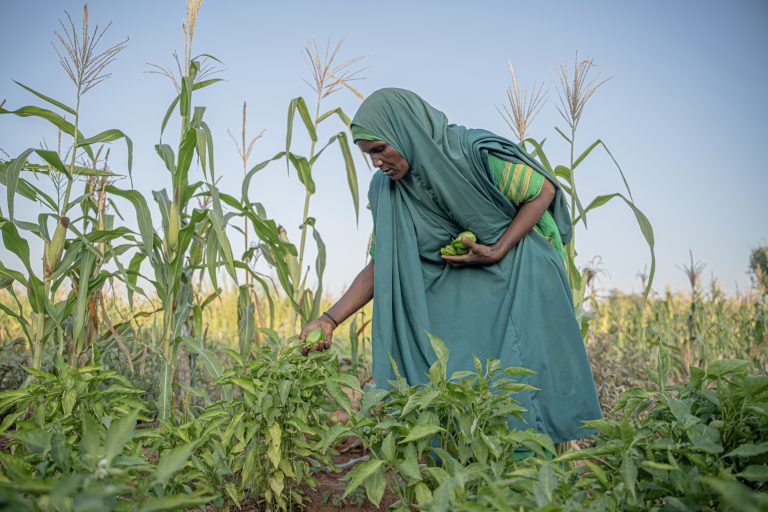
Ubah Weyrah Abdi harvests green peppers from her plot at the collective farm in Qansaxley,
Dollow, Somalia.
Photo credit: FAO/Mahad Said
The gricultural sector is the backbone of Somalia’s economy, but it is also marked by sharp contradictions. On one hand, it is brimming with potential that contributes nearly 20% of the nation’s GDP through crops alone, and an extraordinary 70% when combined with livestock. On the other hand, agriculture remains underdeveloped and highly vulnerable, constrained by weak infrastructure, limited access to finance, and the growing pressures of climate change.
Decades of conflict, poor infrastructure, and climate shocks have left vast portions of this vital sector underperforming. While recent years have brought signs of recovery, unlocking the sector’s full potential will require targeted investments, policy reforms, and strategic innovation.
According to the World Bank, Somalia’s agricultural production is estimated to be worth $751 million annually. The sector also provides livelihoods for the majority of the population. However, the country still runs an agricultural trade deficit of approximately $190 million, importing $460 million worth of food while exporting only $270 million.
This gap highlights both the country’s dependency on imports and the untapped opportunities for increasing domestic production and exports. Recovery from decades of war and instability has been uneven but promising. For example, since 2010, sorghum production has experienced significant volatility with recent production levels remaining well below pre-war peaks, while sesame exports, Somalia’s primary cash crop, now generates $50 million annually.
Somalia’s agricultural landscape varies widely by region. The southern states of Hirshabelle, Southwest and Jubaland, account for 95% of the country’s grain crop production, with Lower Shabelle, Middle Shabelle, and Bay regions, accounting for over 80% of the country’s grain crop production. Lower Shabelle, on the other hand, is the largest contributor to maize production at 51% of total national maize output. Urban peripheries also play an important role, especially in providing fresh produce to growing city populations.
Despite this regional diversity, agricultural productivity across the country remains far below its potential. Sorghum production, for example, currently achieves yields of 0.3-0.6 tons per hectare against a potential of 5-10 tons per hectare. Maize yields average 1.0-1.5 tons per hectare compared to a potential of 10-15 tons per hectare. These gaps reflect systemic constraints, including outdated farming methods, poor water management, and limited access to quality inputs.
Somalia’s agriculture sector faces several structural and operational challenges. Approximately 75% of Somalia’s crop production is through rain-fed systems, which makes the sector highly vulnerable to erratic rainfall and drought. Only 25% of crop production is through irrigation, severely limiting productivity. Between 30-40% of perishable crops like tomatoes, bananas, and citrus are lost each year due to poor storage and handling. This translates into annual economic losses of up to $150 million.
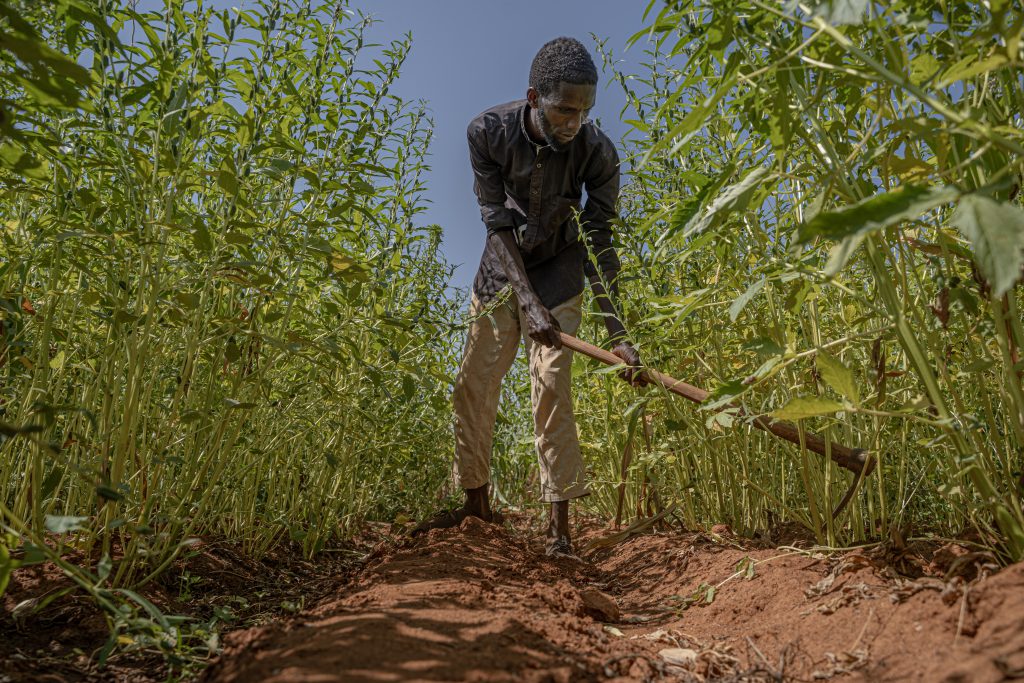
Abdirahman Abdulle Adan works in his plot in Qansaxley, Dollow, Somalia.
Photo credit: FAO/ Mahad Said
Only 15-20% of farmers use improved seeds, and fertilizer use averages just 4 kg per hectare, well below regional standards. Mechanization is rare, with over 80% of farming done manually and only 5% of farms using machinery.
Agricultural policies have also not kept up with the times. There has been no functional national agricultural research center since 1991, and annual agricultural research and development spending is under $2 million. While seven agriculture-related policies have been drafted, four are still pending adoption. Outdated legislation, weak enforcement capacity, and the lack of a clear regulatory framework continue to hold back sector growth.
Despite these challenges, Somalia’s agriculture sector offers high-potential investment opportunities that could transform both rural livelihoods and national economic performance.
“The Somali Development and Reconstruction Bank (SDRB) is working to unlock the power of Somalia’s agriculture by driving investment where it matters most: irrigation, cold storage, value-added processing, and quality inputs,” said Mohamed Abshir, Research and Development Manager at SDRB. “With bold policy reforms, climate-smart solutions, and strong private sector partnerships, SDRB is positioning agriculture as a true engine of inclusive growth, food security, and export competitiveness,” he added.
Strategic investments in infrastructure, input systems, and processing facilities could unlock substantial returns. For example, an estimated $20 million investment in regional cold storage facilities could reduce post-harvest losses and generate annual returns of 18-22%.
A $60 million investment in value-added processing for sesame which are currently exported largely raw could yield margins of 30-35% and help Somalia tap into premium international markets.
Restoring over 50,000 hectares of degraded land through investments in irrigation and climate-smart agriculture is estimated to cost $95 million. However, this investment has the potential to increase maize yields by 50–100%, serving as a benchmark for both cost and impact in similar rehabilitation projects. Furthermore, subsidizing drought-resistant seeds and fertilizers, promoting mechanization, and expanding farmer training can significantly boost productivity and resilience.
To fully capitalize on these opportunities, Somalia must pair investment with policy and institutional reform. The reforms include, accelerating the adoption of pending agricultural policies; enforce food safety and quality standards; and establish a national seed certification system that is fully harmonized with the Common Market for Eastern and Southern Africa (COMESA) and East African Trade Framework.
By investing in climate-smart infrastructure and practices that help farmers adapt to erratic weather patterns and prolonged droughts, farmers across the country will better adopt to climate change.
Somalia’s agricultural sector stands at a critical turning point. While the challenges are significant, the potential rewards are even greater. SDRB champions strategic public and private investments, backed by forward-looking policy reforms and a culture of innovation, to transform agriculture into a powerful engine of inclusive growth, food security, and resilience. With the right interventions, Somalia’s fields could one day not only nourish its own people but also supply markets across the region and beyond.